synlayer
grovera
Pediatric neurodevelopment · evidence and outcomes

Know what's working.

Grovera shows families and clinicians what the evidence says about each intervention, and whether this child is actually changing.

Free for clinicians and familiesIn developmentNo citation, no claim
grovera · plan review · illustrative, not a real child
Age 4 · autism, level 2 · minimal spoken language 3 interventions reviewed
CurrentBehavioral program Moderate evidence
SupportsModerate evidence for social communication in children this age.
UncertainEvidence on hours and duration is inconsistent.

Asked aboutRestrictive diet Flag
Evidence shows no benefitFor core features in controlled trials. Worth discussing with the family.
Adaptive-behavior baseline
No standardized baseline yet. Suggested re-check at six months.
Grovera shows the evidence. You and the family decide.Powered by synlayer
Dozens of lines rising across the frame, each at its own pace, with plateaus and spurts and small rings marking re-checks along the way
Every child grows on their own path. Grovera reads progress against the child's own baseline, not against other children. Illustrative · one line per child · each ring is a re-check

Dozens of interventions, very different evidence, and progress that is rarely measured

Families hear about all of them. Clinicians rarely have time to check each one. Once a program starts, it is hard to tell whether it is helping this child.
1 in 31 US 8-year-olds identified with autism
7.1M US children ever diagnosed with ADHD
2017 the cut-off year of the literature behind a widely used US list of evidence-based autism practices
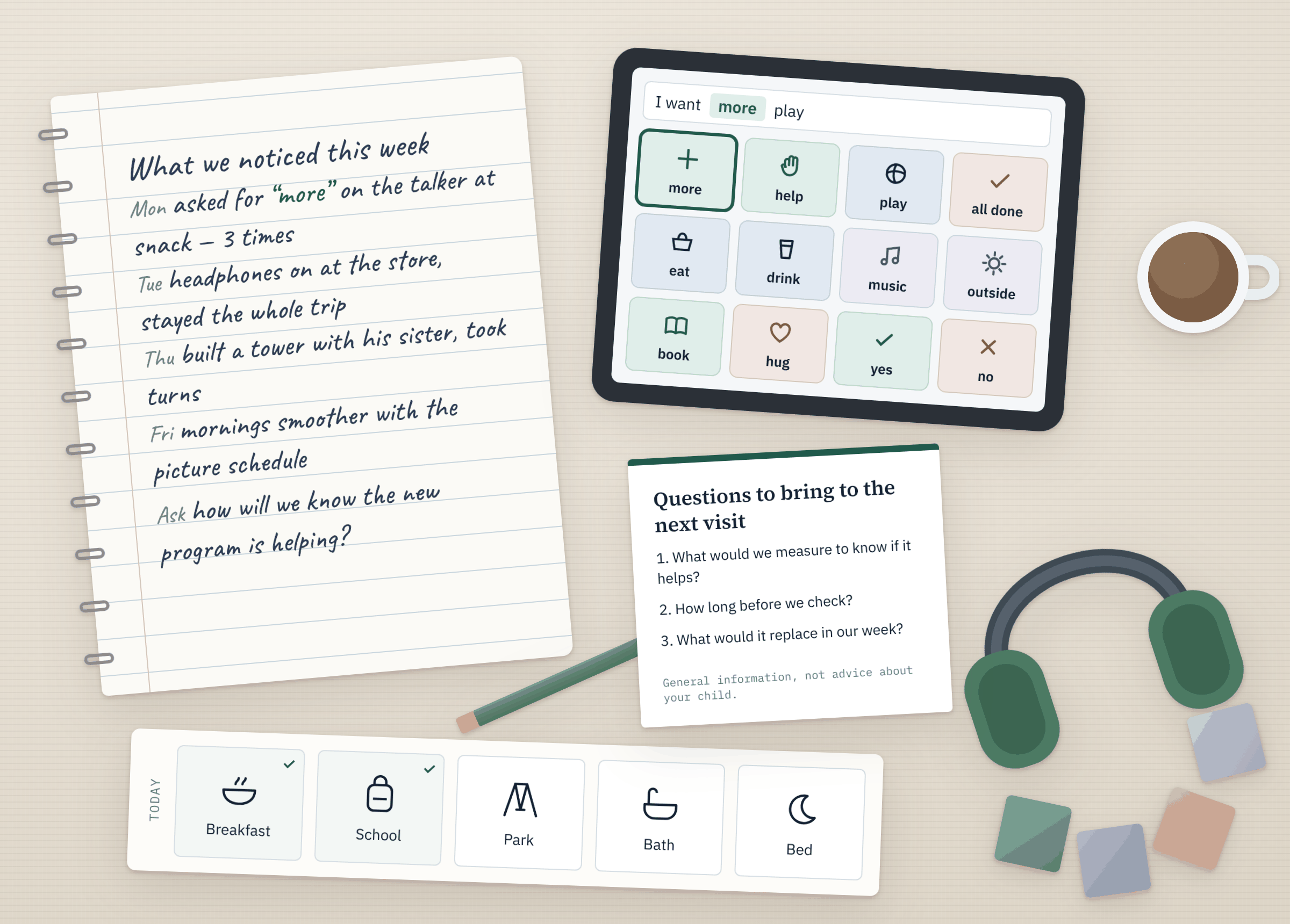
A family's kitchen table: a notebook of what changed this week, a communication tablet showing 'I want more play', noise-reducing headphones, a picture schedule for the day, wooden blocks, and a card of questions to bring to the next visit
Illustrative. The notes and tools are the family's; Grovera helps turn them into questions.
Families and clinicians, together

Parents see the whole week. Clinicians see the visit.

Most change happens at home, at school and at the park. Grovera gives families a way to bring what they see into the plan, and gives clinicians the evidence to talk it through.

  1. 1Notice. A new way to ask for something, a calmer trip to the store, a routine that finally works.
  2. 2Ask. Look up what you read about online and bring plain-language questions to the next visit.
  3. 3Measure together. Parent-reported measures sit beside the clinician's standardized re-checks.
Grovera for families →
How Grovera evaluates

Four questions for every intervention

How it works →
  1. 01 · Population evidenceDoes it work for children like this?Graded by outcome domain and by age and support needs.
  2. 02 · Dose evidenceWhat does the research say about how much?Evidence ranges and their uncertainty. Grovera never sets an hours limit.
  3. 03 · Individual evidenceIs this child changing?A baseline and regular standardized re-checks, read against measurement error.
  4. 04 · Harm and costWhat does it cost, and is there harm?Reported harms, evidence of no benefit, and the time and money involved.
Outcome domains

Progress on what matters to this child

Grovera grades evidence by outcome domain, so a plan is judged on the goals a family cares about. Communication counts in any form: speech, sign or a device.

CommunicationSpeech, sign or a device
Social connectionPlay, friendships, family life
Daily livingRoutines, self-care, independence
Learning and attentionAt school and at home
This childGoals chosen with the family, read against their own baseline
Emotional wellbeingCalm, confidence, sleep
ParticipationSchool, community, what they enjoy
Quality of lifeIncluding the child's own report
Family wellbeingStress, time and cost
Illustrative set. The domains Grovera grades follow the outcomes reported in the research.
Grovera Outcomes · 2027

A measurement, read against its own error

Once a child has a baseline and a re-check, Grovera reports whether the change on a standardized measure is larger than the measure's own error. The calculation is deterministic; no language model is involved.

Change beyond measurement error Within measurement error Not enough data yet
Baseline 6 months 12 months Measurement-error band Beyond error Within error Measure
Illustrative. Not a real child; not a real measure's values.

Who it is for

Clinicians · free · 2027 pilot Grovera Evidence grades for each intervention in a child's plan, what to measure, and what the evidence says to avoid. How it works → ABA and developmental centers · 2027 Grovera for Clinics Standardized outcomes you can benchmark, report and bring to a value-based contract. For organizations → Payers · 2027 pilot Grovera for Payers A consistent, evidence-graded view of outcomes across providers, without turning it into a tool for denying care. For payers → Families · free · 2027 Grovera Family What the evidence says, in plain words, and questions to bring to your child's clinician. For families →
Neutral by design

Grovera shows the evidence. You and the family decide.

How the evidence is graded →
Grovera does
Grade every intervention, including contested ones, by the evidence
Include quality of life and, for older children, their own report
Say when the evidence is uncertain, and how to find out for this child
Grovera does not
Deliver interventions or recommend providers
Set hours or tell anyone to stop
Serve as the basis for denying care
Show advertising

Early access for clinicians and centers

The first clinicians join through a pilot with US developmental centers in 2027.

Request early access
  1. L1 · Shaw KA, et al. Prevalence and early identification of autism spectrum disorder among children aged 4 and 8 years. MMWR Surveill Summ. 2025;74(2). ADDM Network, 2022 data.
  2. L2 · Danielson ML, et al. ADHD prevalence among U.S. children and adolescents in 2022. J Clin Child Adolesc Psychol. 2024.
  3. L3 · Steinbrenner JR, et al. Evidence-based practices for children, youth, and young adults with autism. National Clearinghouse on Autism Evidence and Practice, 2020. Literature 1990–2017.
  4. R1, R2, R3 · Placeholder source ids in the illustrative product screen.